Self Improvement
What “Ask and It Is Given” Taught Me About Emotional Regulation
This isn’t a book review of Ask and It Is Given. It’s a distillation. Beneath the metaphysical framing, I found five practical emotional regulation tools that shifted how I handle frustration, self-doubt, and difficult conversations. You don’t have to believe in the Law of Attraction to benefit from them.
Victoria Englert
|
|
15
min read
This is an after-reading reflection on the book Ask and It Is Given by Esther Hicks. It’s not a book review. It’s a distillation of what I found genuinely useful — and how it connects to my own experience.
Even if you don’t believe in the Law of Attraction, emotional regulation still matters…a lot
I personally believe in the Law of Attraction. But this essay isn’t about persuading you to believe it too.
What I’m interested in is something more practical: emotional regulation.
Strip away the cosmic framing of this book and you’re left with a very grounded claim — that your emotional state shapes your behaviour, your decision-making, and ultimately your outcomes.
And on that front, the scientific evidence is hard to ignore:
Longitudinal research suggests that positive emotions don’t merely follow success — they often precede it. People who experience more frequent positive emotions tend to perform better at work, build stronger relationships, and earn more over time (Lyubomirsky, King, and Diener, 2005).
Barbara Fredrickson’s work on the “broaden-and-build” theory shows that small, everyday positive emotions help you build inner strength over time, so you bounce back better from stress and feel more satisfied with life (Fredrickson, 2011).
Other studies link effective emotion regulation strategies to higher well-being and even socioeconomic status (Côté, Gyurak, Levenson, 2014).
In other words: this isn’t mystical. It’s training.
Your emotional state affects your physiology.
Your physiology influences your decisions.
Your decisions shape your life.
You don’t need to believe in “vibrational alignment” to see that pattern.
Practicing positivity puts you in an upward spiral
Another reason why emotional regulation matters so much is because it kickstarts an upward spiral.
The upward loop works roughly like this:
(a) Practicing positivity makes you better at being positive (practice makes perfect!) → (b) Positive attitude leads to positive experiences → (c) You are motivated to keep being positive → (a)
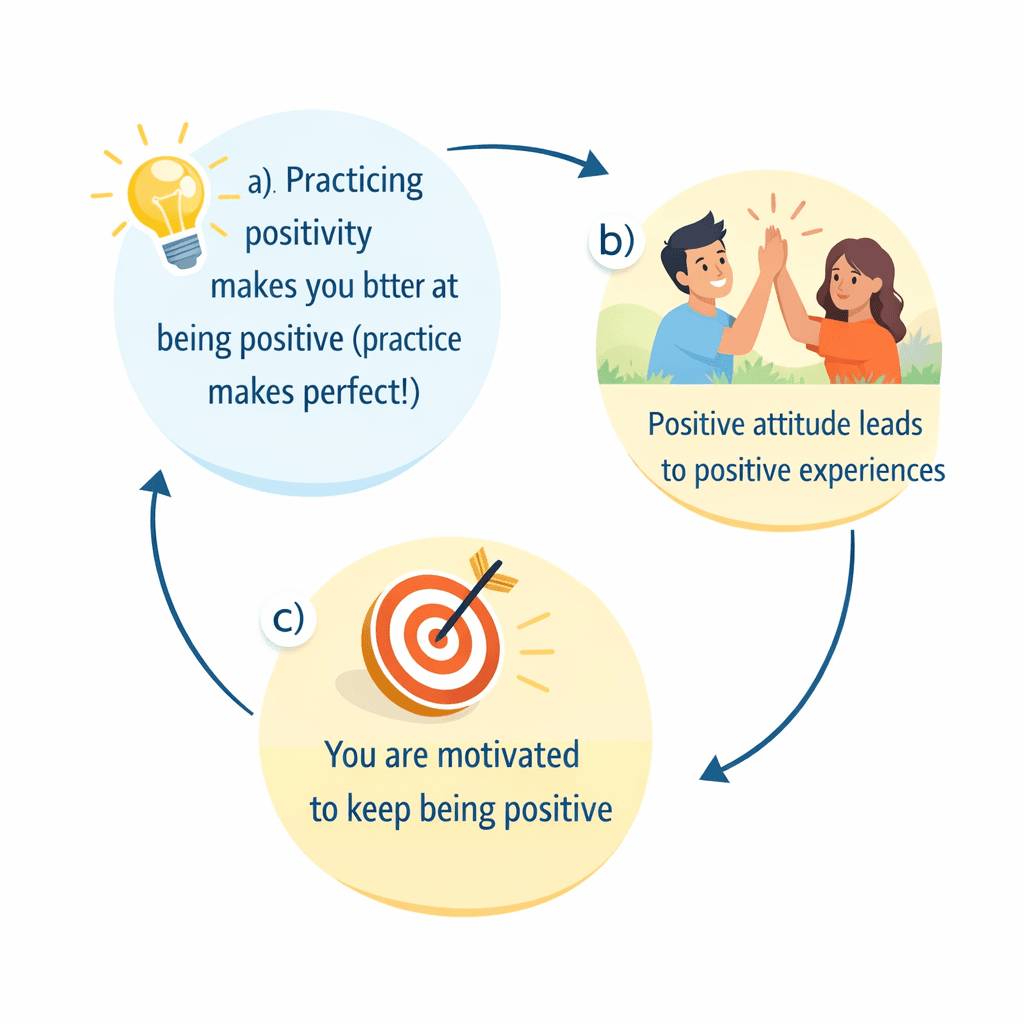
This isn’t about pretending everything is perfect. It’s about deliberately shifting your emotional baseline upward — even slightly.
Over time, this elevated emotional baseline starts to feel like your identity rather than an effort. You gain a sense of agency. You’re less at the mercy of your own reactivity.
So, if emotional regulation is so important, how do you actually practice it?
This is where some of the practices from this book come in handy.
Top 5 emotional regulation “games” that actually stuck with me
Part II of Ask and It Is Given introduces 22 concrete “processes,” framed as games, designed to help shift emotional states deliberately.
Some of them lean heavily into the metaphysical framing. If you don’t buy into the cosmic explanation, parts may feel like a stretch.
And frankly, 22 is too many. Emotional regulation works better when you have a handful of reliable tools you can reach for under pressure.
If you’re curious about the full list, you can find summaries online. What I’m sharing here are the ones that felt psychologically sound and practically usable.
Game #1: The Rampage of Appreciation
This is actually very easy and can be played anytime, anywhere,, because to play this game you simply have to direct positive thoughts in your mind.
It goes like this:
You look around your immediate environment and deliberately focus on something that genuinely pleases you.
You stay with it for a moment. Notice why it pleases you. The color, the texture, the usefulness, the symmetry — whatever registers as pleasant.
The longer you focus on it, the more your positive feelings about it will increase. Pay attention to how your feelings have improved.
Look around and move on to the next pleasant thing.
Repeat this until you feel yourself fill up with appreciation.
This might sound very similar to another popular exercise of “giving thanks”, but there is a subtle difference. Here, you are focusing on things in your immediate surrounding that already feel good.
To illustrate the difference — I used to force structured gratitude exercises in the morning.
"I'm thankful I still have a roof over my head. I'm thankful that I'm not starving.”
These were things that I feel like I OUGHT to be thankful for. They were existential and quite abstract, and while they were all objectively true, I felt nothing.
Often, I actually felt worse — I felt like an ingrate for not harbouring actual gratitude for my “good” fortunes.
This process, on the other hand, is anchored in sensory reality, and removes the moral pressure.
Right now, for example, I’m sitting in a coworking space. There’s a piece of artwork on the wall. I thought, “that’s a nice piece of art.”
There’s nothing existential about it. It doesn’t pull me into a whole cycle about the woes of the world. And all I have to do, is just to move my eyes, and notice the next nice thing. That’s enough to kickstart the “rampage of appreciation”.
What this does, psychologically, is interrupt default negativity bias. It trains attention toward what is functional and pleasant rather than what is lacking.
Game #2: Segment Intending
This one is particularly useful in professional settings.
The idea is simple: instead of drifting through the day on emotional autopilot, you break the day into segments, pause briefly before each one, and decide how you want it to go.
A “segment” can be anything — a meeting, a commute, a workout, writing time, even a conversation with a difficult stakeholder. The book defines a new segment as “any moment your intentions change”. I find that definition too abstract, so I simply use my calendar as a guide.
It goes like this:
Before entering a new segment, pause for a minute.
Ask yourself: What do I want from this? How do I want to show up? How do I want to feel?
Formulate a simple intention — not a fantasy outcome, but a desired quality of experience.
For example:
“I want this meeting to feel constructive.”
“I want to stay calm even if the conversation gets tense.”
“I want to listen more than I speak.”
You’re not trying to control other people. You’re priming yourself.
I used to get so caught up in back-to-back meetings that I would drift into one meeting with my attention still on the previous one. Ever since I started taking the 30 seconds to pause and recalibrate before any meeting, I’ve seen 4 noticeable effects:
I am more attentive to other meeting attendees.
I am able to move the meeting along more efficiently and have a more fruitful discussion because I remember the purpose of the meeting. Whenever someone meanders off topic, I catch it quickly.
I show up as a more confident leader.
I feel emotionally anchored and less exhausted.
What I appreciate about this process is that it shifts attention from outcomes to state. Instead of obsessing over whether you will win the argument or close the deal, you focus on how you want to conduct yourself.
Psychologically, this resembles what performance coaches call implementation intention. By deciding in advance how you want to respond, you reduce the likelihood of reacting impulsively.
The division of the day into segments reduces overwhelm and allows us to exercise this intention in a more focused way.
Game #3: Which Thought Feels Better
This process is particularly useful when you notice a surge of negative emotion — frustration, jealousy, resentment, anxiety — and you can feel yourself tightening around a subject.
The underlying premise is simple: every subject has two sides — what you want, and the absence of what you want. And often, we believe we’re focused on the bright side, when in reality we’re fixated on avoiding the dark side.
For example:
“I want to be rich.” may actually feel like “I don’t have enough money.”
“I want to eat healthy.” may feel like “I’m afraid of getting fat.”
On the surface, the subject is the same. But emotionally, they are very different orientations.
When there’s a gap between the story we tell ourselves (“I’m focused on improvement”) and the emotional signal underneath it (fear, lack, anxiety), that tension creates stress. And stress narrows attention, reinforces scarcity thinking, and makes it harder to act from a place of clarity.
This game helps you detect that difference, so that you can act from a more stable emotional baseline.
It works best alone, with pen and paper. Writing things down matters here. It sharpens your focus and makes it easier to feel the subtle shift between thoughts.
Here’s how to play it:
Write a short statement about the subject that’s bothering you.
Amplify it slightly.
Then say to yourself:
Write a new thought.
You are not looking for the most positive statement. You are looking for relief.
Let’s take a professional example.
You’ve just lost a client.
Initial thoughts:
“I always mess things up.”
“This proves I’m not good enough.”
“Other people are better at this than I am.”
Now begin the process:
“I should have been more attentive.” (worse)
“This one didn’t work out.” (same)
“I didn’t handle that pitch perfectly.” (same)
“I’ve also closed clients before.” (slightly better)
“Not every proposal converts.” (better)
“This is data I can learn from.” (better)
“One client does not define my capability.” (better)
Notice that we didn’t jump to:
“Everything happens for a reason.”
“This is the best thing that could have happened.”
Those might feel false. And if a thought feels false, it won’t create relief.
Another example — finances:
Starting point:
“I don’t have enough money.”
“I’m falling behind.”
“This is stressful.”
Now shift:
“Money feels tight right now.” (same)
“I’m just bad with finances.” (worse)
“I wish my job pays better.” (worse)
“There are areas I can optimize.” (slightly better)
“I have handled tight periods before.” (better)
“I am actively working on improving this.” (better)
“This is a temporary phase, not a permanent identity.” (better)
Do this until you can produce a series of thoughts that feel noticeably lighter than your starting point.
The value of this exercise is not in magically changing circumstances. It’s in increasing awareness of how different thoughts land in your body. Over time, you become more skilled at noticing how you actually feel.
Once you can feel the difference, you regain choice. And other emotional regulation techniques become more effective.
Game #4: Pivoting
Pivoting is the conscious decision to identify what you do want, especially in the moment you realize you are mentally rehearsing what you don’t.
The book makes a subtle but important point: negative emotion is not a flaw in your character. It is information. It signals that you are currently focused on the absence of something you care about. Frustration, jealousy, resentment — these are not problems to suppress. They are indicators that a preference is trying to surface.
The process itself is simple, though not always easy.
Notice the negative emotion.
Acknowledge it without judging yourself for having it.
Ask: If this is what I don’t want, what do I want instead?
Articulate that clearly and deliberately.
Stay with that preference long enough for it to reorganize your thinking.
I remember a period when I felt deeply frustrated working in Germany because my German was not fluent enough for complex discussions. In meetings, I could follow the general direction, but when it came to nuance, I struggled. My colleagues expressed themselves effortlessly, and I often left feeling invisible and slightly embarrassed.
My internal narrative revolved around what was missing: “I can’t keep up.” “They probably think I’m less competent.” “I hate that I can’t express myself properly.”
That frustration lingered for quite some time. Improving my German quickly was not realistic. Language acquisition at that level takes years, not weeks. So the idea of simply “getting better” did not immediately resolve the tension.
When I began to pivot, the question I asked myself was straightforward: If this is what I don’t want, what do I want?
The answer was not “perfect German.”
It was: “I want to express myself freely and precisely.”
That clarification shifted the entire frame. Instead of fixating on linguistic deficiency, I was now anchored in a preference for clarity and contribution.
From there, two paths became visible. One was the long-term path of continuing to improve my German, knowing it would take time. The other was more immediate and far less comfortable: requesting that certain meetings be conducted in English.
The latter required setting a boundary I had previously avoided. I was afraid it would signal weakness. But once I defined clearly what I wanted — the ability to contribute fully — the request became logical rather than emotional. It was no longer about complaining. It was about aligning conditions with my stated preference.
The external situation did not transform overnight, and my German remained imperfect for a long time. What changed was my orientation. I moved from rehearsing inadequacy to defining what would allow me to participate meaningfully.
That is the essence of pivoting.
Negative emotion tells you that you are staring at the unwanted end of the stick. Pivoting asks you to turn toward the preferred end and hold your attention there long enough to clarify your direction. The action that follows may not be easy, but it becomes coherent.
Whenever irritation or envy arises, the question remains useful: If this is not what I want, what do I want instead?
Often, the answer contains the next courageous step.
Game #5: The Focus Wheel
The Focus Wheel is different from the previous exercises because it works at the level of beliefs rather than individual thoughts.
Sometimes the problem is not that you are having one negative thought. It is that you hold an underlying belief that makes certain negative thoughts almost automatic. You may want something — confidence, stability, competence — but deep down you do not yet believe it is available to you.
The Focus Wheel is a way of building a believable bridge between where you are and where you want to be.
It is most useful when:
You feel strong negative emotion about something important.
You notice that your current belief is not serving you.
You want relief, but jumping straight into positivity feels fake.
Here is how the process works.
Take a sheet of paper and draw a large circle. Inside it, draw a smaller circle in the center. Imagine the large circle as a clock face.
In the small circle in the center, write the statement that represents how you want to feel or what you want to believe. This is the core intention you will build around.
For example, when I was learning to drive in Germany, I felt overwhelmed and broke down a few times. The lessons were in German (I kept hearing “recht” as “left”). In Germany you drive on the right, while in Singapore you drive on the left. I was getting yelled at by my driving instructors, and I couldn’t talk back. My internal narrative sounded like this:
“I’m terrible at this.”
“I’ll never get it.”
“Everyone else seems to manage.”
If I had written in the center, “I am an excellent driver,” it would have felt ridiculous. My body would have rejected it immediately.
Instead, I wrote something more honest but forward-facing in the center:
“I want to feel capable and calm while driving.”
Now the work begins.
Around the outer circle — starting at the 1 o’clock position and moving clockwise to 2, 3, 4, and so on until you reach 12 — you write twelve statements that lean toward that central desire. Each statement must meet one requirement: it has to feel believable enough that it “sticks.”
If a statement feels exaggerated or false, you skip it. The goal is not inspiration. The goal is stability.
In my case, the outer statements looked something like this:
1 o’clock:
“Many people feel nervous when learning to drive.”
2 o’clock:
“Driving is a skill that improves with repetition.”
3 o’clock:
“It’s reasonable that this feels hard in a different language.”
4 o’clock:
“I could find videos that explain the concepts in English.”
5 o’clock:
“The exam could be taken in English.”
6 o’clock:
“I have enough money to get extra lessons.”
7 o’clock:
“I am already better than I was in my first lesson.”
8 o’clock:
“I can focus on one improvement at a time.”
9 o’clock:
“It’s very common to not pass the driving exam on the first try.”
10 o’clock:
“With enough practice, this will feel more natural.”
11 o’clock:
“I am capable of being a good driver.”
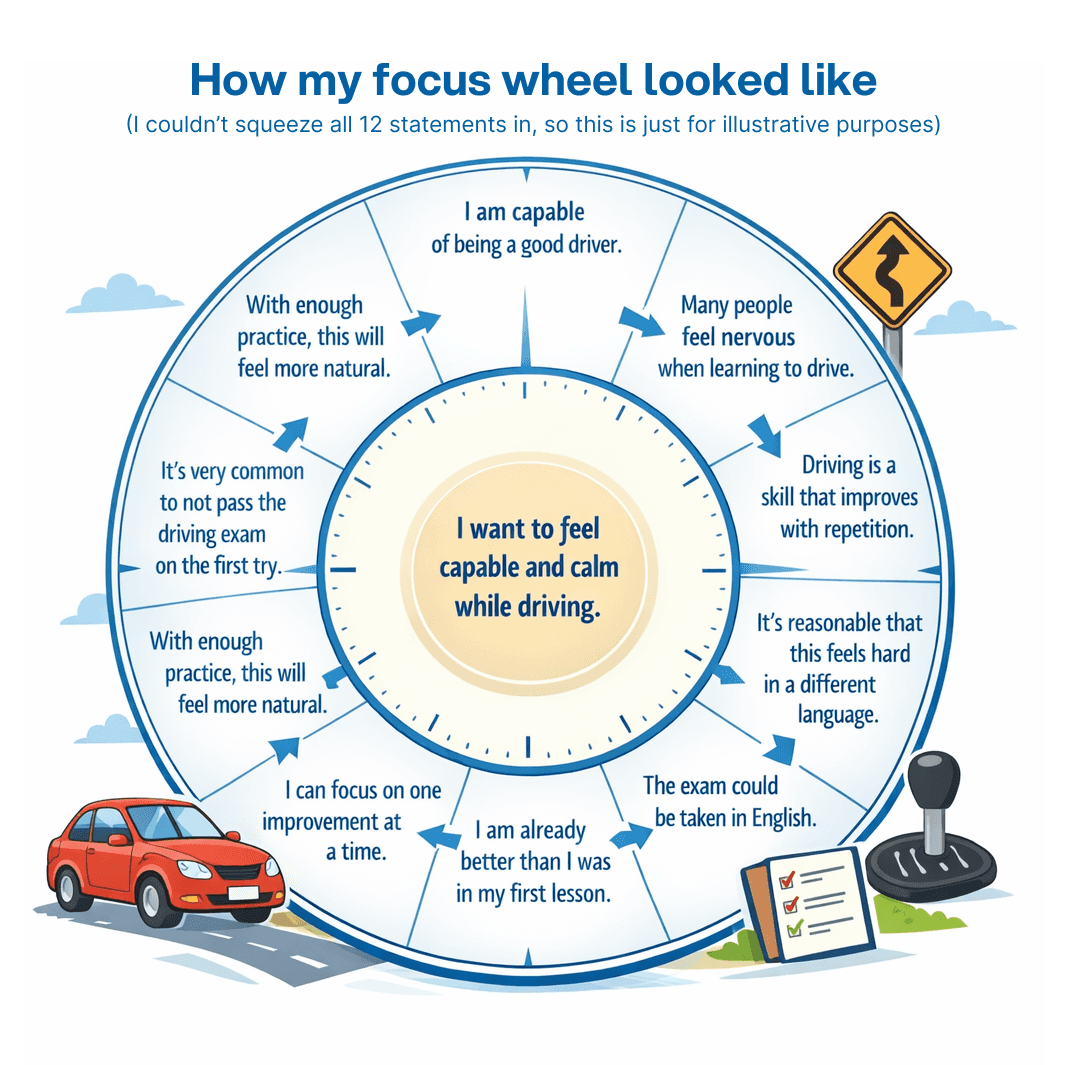
Notice that none of these statements are grand. They are general, stable, and already somewhat true.
As you move around the clock face, you are not forcing belief. You are collecting thoughts that gradually shift your orientation. By the time you return visually to the center statement, it often feels less distant. The emotional charge around the subject softens.
The key difference between this and “Which Thought Feels Better” is scale. There, you are adjusting a thought in real time. Here, you are deliberately constructing a supportive belief structure around a desired state.
The book frames this as shifting your vibrational point of attraction. You could also see it as cognitive scaffolding. When a belief feels too far away, you slow it down, step onto something more stable, and then allow momentum to build gradually.
The process takes fifteen or twenty minutes, which is precisely why it can work. It interrupts the automatic pattern long enough for a new one to form.
Used occasionally, especially on subjects that trigger strong emotion, the Focus Wheel can loosen beliefs that previously felt fixed.
And just to finish the story, I passed my driving exam with perfect scores in both theory and practical on the first try.
Closing Thoughts
Ask and It Is Given is not a light read. It is long, repetitive at times, and unapologetically steeped in metaphysical language. If you are allergic to anything that sounds even remotely “woo,” parts of it may test your patience.
And yet, underneath the cosmic framing, there is something genuinely useful: a structured approach to emotional regulation.
You do not have to believe in vibrational frequencies or universal orchestration to benefit from the core practices. At their heart, these processes train attention, clarify preference, and gently restructure belief. That alone is powerful.
Emotional regulation is not about pretending everything is fine. It is about becoming more deliberate with where you place your attention and how you shape your internal narrative. Over time, that deliberateness compounds.
I hope this distilled set of five tools offers you a practical entry point. You can adopt the language of vibration if it resonates with you, or you can think of these as cognitive exercises. Either way, the mechanism is trainable.
At the very least, the next time irritation or self-doubt surfaces, you might pause and ask a different question.
And that small pause, repeated often enough, can change quite a lot.

Thank you for reading!
If you enjoyed the article and would like to buy me a nice cup of cappucino,
👉 support me on Ko-fi
How to export and self-host your Webstudio site with a Wordpress headless CMS
Should you use Webstudio? Confessions from a Webflow junkie
Why New Year’s Resolutions Rarely Work — and What Does Instead
How to Register as an Einzelnunternehmer in Germany: A Practical Guide for Solopreneurs / Freelancers
Useful Resources for Aspiring Pigeon Rescuers
What “Ask and It Is Given” Taught Me About Emotional Regulation
Trapped in your own business
I Replaced Notion With My Own AI CRM. Here's My Process.
“Help! Why can’t I get anything done?” — A letter from a small business owner
The REAL Reasons Your Project Management Tool Failed