Self Improvement
Why New Year’s Resolutions Rarely Work — and What Does Instead
Fresh starts only work when they’re felt. I explore why New Year’s often doesn’t — and what to use instead.
Victoria Englert
|
|
7
min read
TL;DR:
Fresh starts only work when they’re felt. I explore why New Year’s often doesn’t — and what to use instead.
Intro: Feeling unmotivated by New Year’s resolutions
Today is the 26th of January. I stared at the task “Do year start planning” on my todo list, and quietly moved it to the next day…again.
As a person who thinks of herself as motivated and productive (and has freshly struck out on her own), this feels like a set back. It’s only reasonable to have clear goals and a plan for the year ahead, aligned with standard business cycles, isn’t it?
The fresh start effect is real — and genuinely useful
The reason why “New Year’s resolution” is so deeply entrenched in our cultural psyche is that the fresh start effect is real.
According to a paper by Wharton University researchers Dai, Milkman & Riis, people are “more likely to tackle their goals immediately following salient temporal landmarks”, which, in layman’s terms, simply means specific points in time that stand out from the ordinary”. This helps explain why gyms see a surge in attendance after New Year’s, and why Google searches related to dieting spike around the same moments.
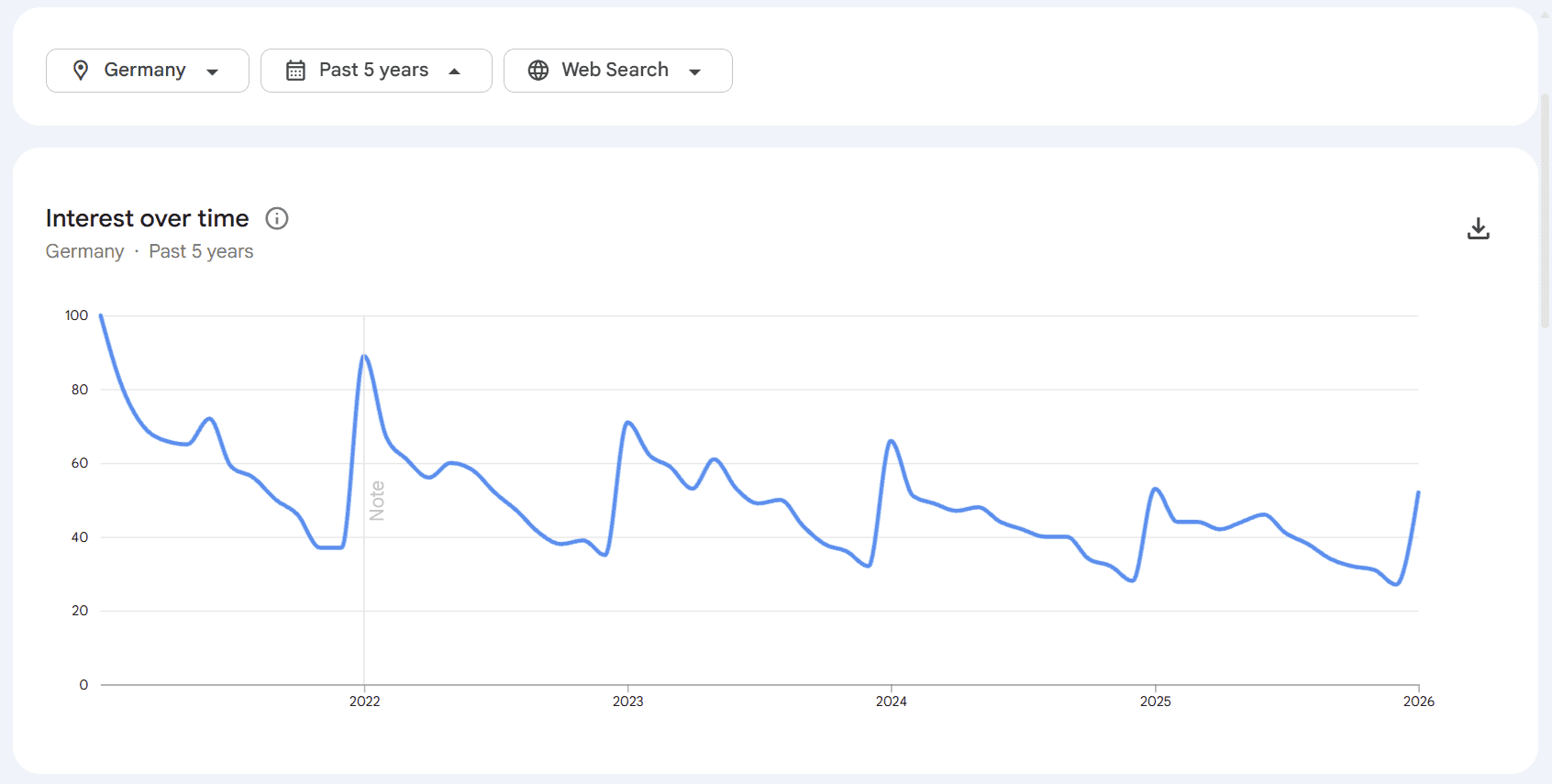
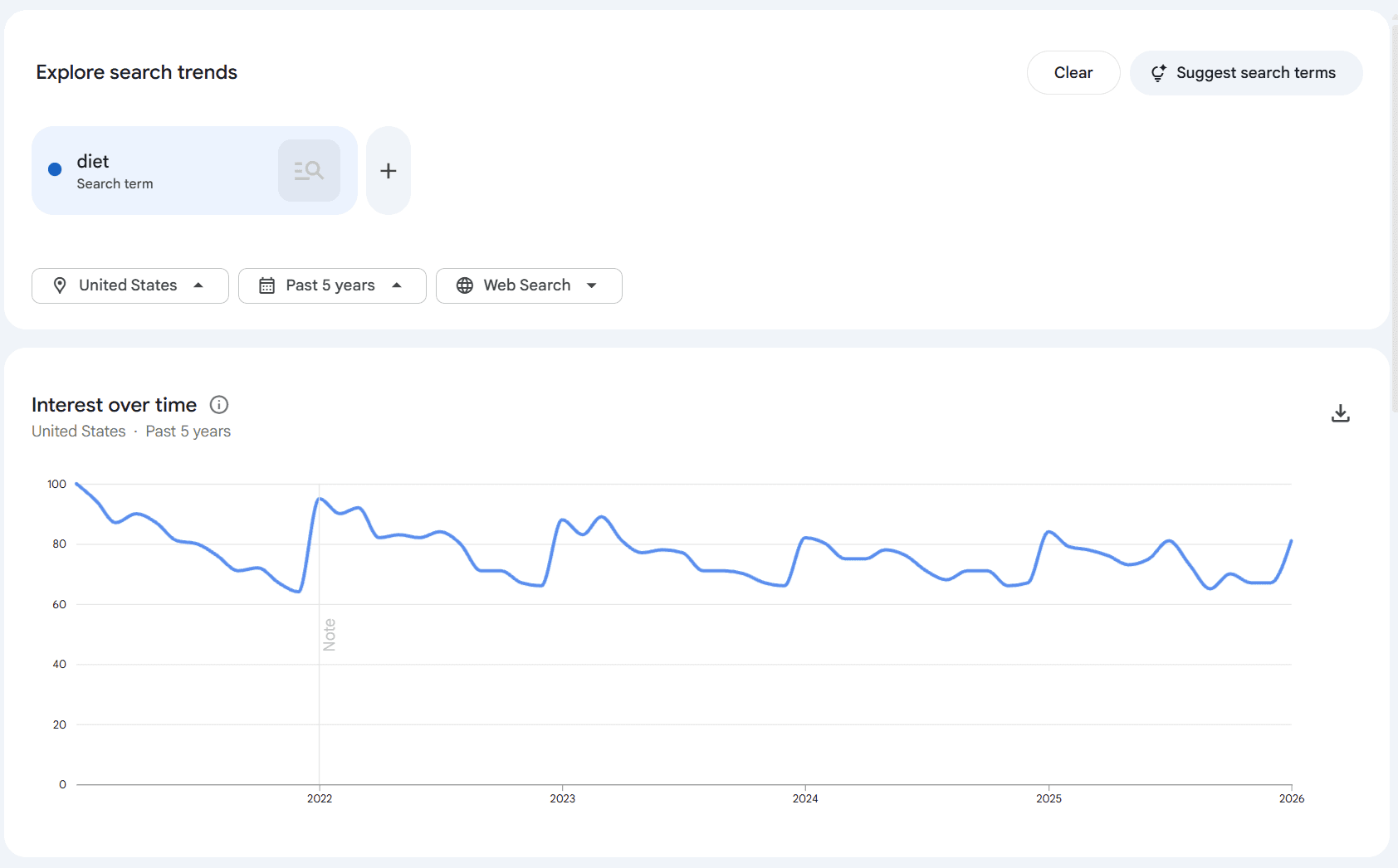
What makes this effect genuinely useful is not that it magically increases discipline or willpower. It’s that it changes how we relate to our past selves.
In a follow-up paper by the same researchers, they describe how temporal landmarks create a psychological boundary between “who I was” and “who I want to be.” That boundary creates a brief but powerful mental distance from past failures, missed intentions, or habits we’re unhappy with.
In other words, fresh starts lower the emotional cost of starting. When the past feels less entangled with the present, it becomes easier to try again without dragging along shame, guilt, or the internal narrative of “I’ve failed at this before.” This is why the effect shows up so clearly in initiation behaviors: signing up for a new course, showing up to the gym, beginning something new.
But if this effect is real, why does New Year’s resolution feel so…overrated?
If your New Year’s resolution feels hollow and not motivating, well – join the club. Sustaining a new habit is hard enough. When a goal doesn’t feel intrinsically motivating to begin with, sticking to it becomes even harder.
The problem, I find, is that New Year’s means very little to many people, myself included. Yes, it is a widely celebrated temporal landmark. but other than the obvious logistical arrangements (having to buy a new desk calendar), it feels largely disconnected from my lived experiences.
In Germany, where I live, literally nothing changes between 31st December and 1st January. Winter persists, light doesn’t return, energy doesn’t shift. The environment offers no signal that something genuinely new has begun.
(What’s worse, in recent years, I started noticing dead and injured pigeons from the fireworks on the streets. This definitely did not add to any positive feelings about the holiday.)
On top of that, New Year’s carries a heavy layer of social obligation. The desire to change is often amplified not by inner readiness, but by collective hype: everyone else is starting over, so you feel like you should too. While peer pressure can be motivating, it doesn’t build internal meaning. Long-lasting changes need to be driven by core identity, and identity doesn’t shift unless you truly want it to.
So when the resolution is carried by hype, it tends to evaporate when the hype dies down.
What this reveals is a quiet but important truth: meaning matters more than timing. A fresh start only works if it feels like one. When a temporal landmark doesn’t resonate emotionally or bodily, it can't deliver the psychological separation it promises. Instead of shedding an old identity, we carry the same expectations, patterns, and self-judgments straight into the New Year — while pretending that we aren’t.
Once you start noticing this, the problem with New Year’s becomes hard to unsee. This doesn’t mean fresh starts are flawed. It means many of the ones we rely on are poorly chosen.
We are better off using natural cycles as our personal temporal landmarks
Just to be clear, I’m not saying New Years are poor temporal landmarks for everyone, or that all New Year’s fresh starts are doomed. All I’m saying is – if meaning matters more than timing, it makes sense to look for fresh starts in places where meaning already exists.
For most of human history, those places were not calendars on walls, but cycles in nature.
Our current civil calendar, the Gregorian calendar, is the latest product of a long line of systems designed primarily for political and bureaucratic convenience. It was shaped by Roman administrative needs, such as marking when consuls took office, rather than by how humans experience seasons, light, or energy.
In contrast, many other calendars — such as the Chinese calendar or the Hebrew calendar — are explicitly designed to align human activities with natural cycles. Dates of significance are not abstract, but rather visible, embodied, and emotionally charged.
Take Lunar New Year as an example. Unlike January 1st, it coincides with a real seasonal turning point: days grow longer, warmth slowly returns, and collective anticipation builds. Even if you’re not consciously tracking the lunar calendar, the body registers the change. Renewal feels plausible because the world itself is waking up.
If you were a farmer in ancient China, that physical and emotional connection was even starker. The Lunar New Year marks the beginning of a new life after months of bitter cold and scarcity. This transition is not symbolic, but physical and existential.
“But I’m not a farmer in ancient China.” – Neither am I, but the same logic applies in other places.
Menstrual cycles, for instance, come with predictable hormonal shifts that affect energy, focus, and the need for rest or recovery. I used to detest myself for feeling depleted and unwell during my menstruation. In recent years I’ve learnt to appreciate these cycles as personal temporal landmarks instead. I plan high-energy activities in my follicular phase, and rest and reassessment during my period.
Lunar cycles operate similarly. Even if you are not a werewolf, the moon does have measurable, practical effects on the environment and on human behaviour. Tide strength is driven by lunar cycles, and outdoor athletes will attest to how important moonlight conditions are for nighttime activities. It’s no coincidence that many sports watches now include lunar cycle tracking.
Another popular temporal landmark is birthdays. While their symbolic meaning differs from person to person, few things trigger reflection as reliably as noticing yourself get older. A tangible number is attached to the years you’ve lived on earth, and the linear nature of time suddenly feels very real.
What all these landmarks share isn’t mysticism or tradition for its own sake, but rather alignment between internal experience with external change. When we recognize and work with the natural cycles we already live within, the psychological separation feels real. Fresh starts become acts of cooperation — with nature, with time, and with ourselves — rather than something forced upon us or driven by sheer willpower.
But if these cycles are too long, you don’t have to wait
The shortest daily cycle we experience is — you guessed it — sunrise and sunset.
(If you happen to live in one of those places where the sun doesn’t rise or set for months on end, well… tough luck. This works a bit differently for you.)
This means that, in theory, you’re offered a fresh start every single day.
In practice, of course, most of us don’t wake up feeling spanking new every morning. So clearly, these natural signals alone aren’t enough. The question then becomes: how do we turn them into useful resets?
The key here is mindfulness. We’ve already discussed how a temporal landmark can only be effective when it’s connected to your emotions. When something happens daily (and can be somewhat mundane), it only becomes meaningful if you are deliberate about it. Rituals, however small, can be surprisingly effective at marking transitions, as long as they’re noticed rather than rushed through.
For many people, showering fits the bill of a great daily ritual. You step into an enclosed space, feel water on your entire body, and gain a rare moment of privacy. For a few minutes, your mind declutters and resets. This is why so many random thoughts surface in the shower. Quietly adding a boundary-marking sentence, such as “Today is a new day. This is where I begin again,” can make that transition more tangible.
The same applies to nighttime routines. Removing makeup, changing clothes, dimming the lights, getting ready for bed — these are all signals that one phase has ended and another can begin. If it helps, you might gently name that boundary to yourself: “Today is complete. Tomorrow I start afresh.”
These moments don’t need to be optimized or aestheticized. Their power lies in attention, not repetition. Without it, they remain habits. With it, they become real resets.
Conclusion: best fresh start markers are those that are meaningful to YOU
The fresh start effect is real, but it isn’t universal. It only works when the temporal landmark behind it is physically and emotionally relevant to the person experiencing it.
This is why New Year’s resolutions fail so often. January 1st is highly visible and socially reinforced, but for many people it isn’t felt in the body, the environment, or their emotional state. The date changes, but nothing else does. When a fresh start lacks relevance, no amount of marking or collective enthusiasm can make it stick.
What works better are temporal landmarks that align with lived experience: seasonal shifts you can sense, bodily rhythms that affect energy and focus, daily transitions that already structure your attention. These landmarks don’t impose change — they support it.
Because those rhythms differ from person to person, there is no single “correct” fresh start. The more useful question isn’t when should I begin, but when does beginning actually feel possible for me. Answering that requires observation rather than discipline — noticing when you have energy, when reflection comes naturally, and when letting go feels easier than pushing forward.
Fresh starts aren’t something you schedule once a year. They’re something you learn to recognize. And when they’re grounded in your own physical and emotional reality, they stop feeling like an act of willpower — and start feeling like a natural next step.
The most effective fresh starts aren’t universal. They’re personal.

Thank you for reading!
If you enjoyed the article and would like to buy me a nice cup of cappucino,
👉 support me on Ko-fi
How to export and self-host your Webstudio site with a Wordpress headless CMS
Should you use Webstudio? Confessions from a Webflow junkie
Why New Year’s Resolutions Rarely Work — and What Does Instead
How to Register as an Einzelnunternehmer in Germany: A Practical Guide for Solopreneurs / Freelancers
Useful Resources for Aspiring Pigeon Rescuers
What “Ask and It Is Given” Taught Me About Emotional Regulation
Trapped in your own business
I Replaced Notion With My Own AI CRM. Here's My Process.
“Help! Why can’t I get anything done?” — A letter from a small business owner
The REAL Reasons Your Project Management Tool Failed