Entrepreneurship
How to Register as an Einzelnunternehmer in Germany: A Practical Guide for Solopreneurs / Freelancers
A step-by-step guide to registering as a solopreneur in Germany, focusing on the decisions that matter before you fill out any forms.
Victoria Englert
|
|
10
min read
TLDR: I recently registered as a solopreneur in Germany and wrote down everything I wish I’d known beforehand. This guide walks you through the decisions that matter most, so the bureaucracy doesn’t derail you before you even start.
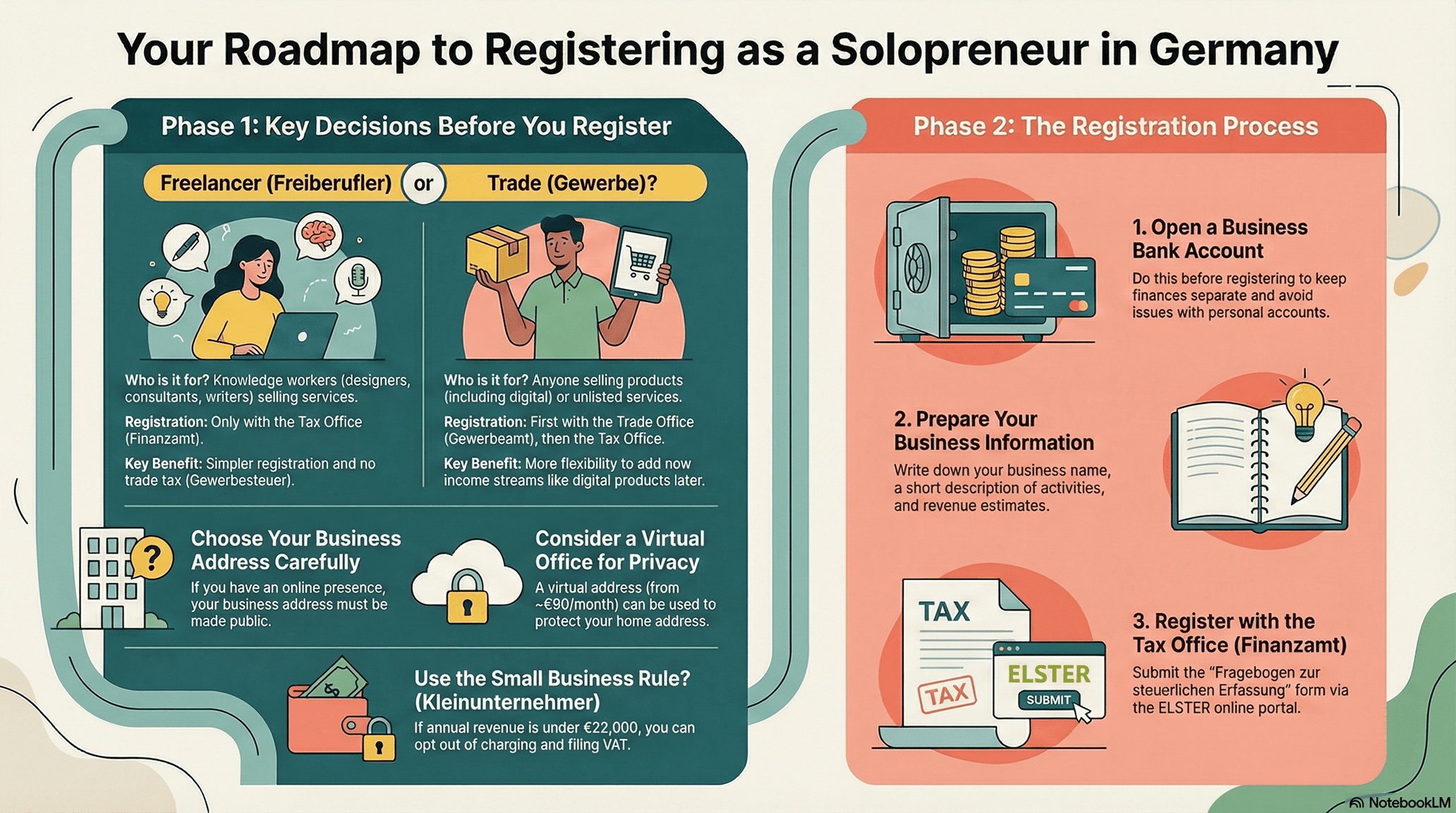
Starting out as a solopreneur? Welcome to the club.
Starting a business, even as a solopreneuer, is a daunting task in Germany. I remember back in Singapore, I could complete a business registration within half an hour. In Germany? No chance.
If you are embarking on the same journey, let me prepare you psychologically:
There are bundles of decisions about legal forms and taxes that you need to make prior to the actual registration.
The forms are convoluted and anti-human.
Every state has its own system for dealing with these administration.
The written language is not easy to understand, even for native germans, let alone for non-native speakers.
Good news is, registering as a Einzelnunternehmer is much less complicated than registering as a UG or GmbH, so it’s the easiest way to get your business started in Germany.
Why I’m putting this guide together
While ChatGPT has been very helpful as a companion through filling out the forms, I honestly would still have been lost if I didn’t have a business coach who gave me an overview and helped me kick-start this process.
But of course, not everyone had the luxury of having access to a business coach, and frankly — doing this with me has been a waste of his talents. That’s why I’m writing everything I’ve learnt during this registration into a guide, and hopefully this helps take some of that starting jitters away .
Who this guide is for (and who it’s not)
This guide is for you if you:
Want to register as a solopreneur in Germany. This includes being a freelancer (selling service) or sole trader (selling products), either part-time or full-time.
Do knowledge work: consulting, design, marketing, IT, writing, research, strategy, etc.
Are getting ready to register with the Finanzamt and/or the Gewerbeamt.
Need an overview of the process to calm your nerves, and tips on how to avoid common mistakes that lead to delays, privacy issues, or rework later.
This guide is not about:
Setting up a GmbH or UG
Trade-specific permits (crafts, food, retail, medical professions)
Tax optimisation strategies (this is about registration, not tax planning)
1. Decide if you are a Freelancer or a Gewerbe
Germany has a complicated and frankly quite an outdated way of classifying solopreneurship, but it’s important to get this right right from the start. Not having the right classification could run you into tax problems and more admin headaches later.
Knowledge workers usually are considered “Freiberufler”
Typically as a knowledge worker who wants to work independently, you are considered a freelancer “Freiberufler’. Examples include:
Designers, writers, journalists
Consultants and advisors
Developers and engineers
Researchers, educators, translators
The problem: many modern roles sit in grey zones. Marketing, strategy, product, growth, content, or “general consulting” don’t always map cleanly to classic categories.
In those cases:
You can still apply as a freelancer
The Finanzamt decides, not you
They may reclassify you later
In any case, if you are registering just to be able to pick up freelance projects, then stick to being a Freiberufler.
If you ever thought of selling digital products, register as a “Gewerbe”
The moment you start earning money through putting templates for sale, or through subscriptions to your app, you’re no longer just a Freiberufler. That part of your business from sales is now a trade (“Gewerbe”).
If you are still just a “Freiberufler” then, depending on the size and portion of that income, you might run into problems with the Finanzamt later. The worst-case consequences of that could be:
blanket application of trade taxes on all your activities
retroactive adjustements to your income
plus a lot more admin headaches
That’s why I’ve registered as a Gewerbe, even though I am not selling any product right now, because it gives me more flexibility and less friction when adding other sources of income later.
Specifically:
I can sell digital products alongside services
I can add new revenue streams later without reclassification anxiety
I avoid debates about whether something is “still freelance enough”
It’s a bit more upfront admin and potentially trade tax (”Gewerbesteuer”), but it doesn’t cost much the optionality was worth it.
This is also the option that I’ll advice anyone who’s thinking of productizing themselves. Set up now, save some headache.
But if you’re unsure, just register as a freelancer first. You can register for Gewerbe later as well.
2. Decide what your business address should be
This was something that I only learnt midway through the form.
You’ll have to disclose your address if you have an online presence
In Germany, there’s something called Digitale-Dienste-Gesetz (DDG). This means that if you have any online presence:
A website
A blog
A newsletter with a public sign-up page
A landing page offering services
An app
A public platform profile used commercially
your full legal name + A reachable business address must be publicly visible (e.g. in your website imprint / legal notice).
So if your business address is also your home address, then your home address is out in the open.
Some people are more sensitive to this than others — it’s a privacy decision that you should make up front.
If you don’t plan on ever having an online presence…
…then I’m very curious to how you conduct your businesss 😄
But jokes aside, if you don’t have a website or any of the online presence above, you do not have to publish your address anywhere. That’s one of the privacy advantages of being an Einzelnunternehmer vs. being a UG or GmbH.
You could get a virtual office address instead
If you dislike the idea of publishing your home address anywhere, there are virtual offices that offer a variety of services depending on your needs. Some of them offer add-on packages, such as a front desk or a receptionist, and some even have meeting rooms that you can book on demand.
Just having a registra-able business address costs at least €90/month in Germany (depending on city and the exact location. One such service provider is Regus, but do Google “Geschäftsadresse [city name]” for other options.
But do pay attention: not all business addresses usable as mail forwarding services can be used for business registrations.
If this is overwhelming, choose the easiest option first. You can changing the address later, and it’s less complicated for an Einzelnunternehmer is possible — just annoying.
3. Get a business bank account (strongly recommended)
Legally, freelancers and sole traders in Germany are allowed to use a private bank account for business. BUT if you would take my advice — don’t do that. Open a business bank account before registration, and keep your personal and business banking separate.
Why? Because:
If a bank account is frozen due to compliance checks or automated flags, it’s far safer for that to be your business account rather than the one you rely on for rent and daily life.
You save time on bookkeeping, no need to reclassify expenses, reduces questions from the tax office. It’s also easier for an accountant to step in later.
Many clients, platforms, and payment providers expect a business account.
Which bank to choose for business account
There is enough here for a whole other article, so I’ll just share what I chose in the end — Vivid Money. I’ve started with the “Selbstständige Standard” plan. The most important criteria for me:
It’s free
Allows me to have multiple “pockets” — great for budgeting
Allows me to accrue interest (currently at 4%)
Free (multiple) virtual and physical cards
Free SEPA transfers and free incoming SWIFT (you have no idea how many banks CHARGE MONEY for SEPA transfers — no idea how they could justify this)
Integration with major accounting softwares
Book keeping features like uploading invoices to your transactions
Most importantly, Vivid allowed me to open a business account before getting a business tax number (”Steuernummer”).
This is a weird catch-22 I experienced with other banks: they required a business Steuernummer to open a business bank account, but I don’t have the Steuernummer until I complete the registeration. But without a business account, I could not complete the registeration…
The advice I got was to first use my private bank account and then change it later, which is troublesome.
But since Vivid didn’t have that as a requirement, I could open my bank account with them and use it directly in my registration.
4. Decide if you want to be considered a Kleinunternehmer
When registering your business, you must decide whether to apply the Kleinunternehmerregelung. The Kleinunternehmerregelung is a German VAT rule that allows small businesses with annual revenue of up to €22,000 in the previous year and €50,000 in the current year to operate without charging VAT on their invoices. This is a regulation that stipulates how VAT is handled only — not your legal status or business scope. It also doesn’t mean that if you don’t opt for this, you are not a small business.
Why this often makes sense when starting out
The main point of this regulation is help young businesses avoid the administrative burden of dealing with VAT. You don’t charge VAT on invoices, you don’t file VAT returns.
For B2B clients, it doesn’t make any difference (they don’t pay VAT anyway). But if you are dealing with end consumers, it can make your product appear cheaper.
When opting out may be the better choice
But opting in also means that you cannot claim VAT refunds.
So if you are expecting significant expenses with VAT (like running a one-person crypto farm with lots of hardware required), you should not opt in to this.
Also, if you know that you’ll exceed the threshold of €22,000 - €50,000 soon (having landed a fat consulting deal perhaps), You may want to charge VAT from the start to save the admin hassle later).
5. Prepare basic business information
You should prepare a reference document with the following info, because these will be needed in the form:
Business name (”Bezeichnung des Unternehmens”)
Description of activity (”Tätigkeitsbeschreibung”) (200 characters only)
Planned start date
Revenue estimate
Having this written down somewhere (even just a Notes app or a Google Doc) is important as you might have to enter this several times later with different authorities.
Let’s go through them one by one.
a. Business name (”Bezeichnung des Unternehmens”)
On ELSTER, you’ll be given a bunch of examples of what “acceptable” companies names are:
This field is not a brand name field. It’s the geschäftliche Bezeichnung the Finanzamt uses to identify your activity on files, letters, and tax records.
For Einzelunternehmen, the safe and standard format is:
[Brand name] – [short activity description]
So it’s not just your name.
It’s also ok to operate under a name that is not your own name.
In my case, I’ve registered my company under “BeaverStack – Digitale Produkte & Beratung”.
b. Description of activity
This is a 200 character description of your a activity. The Finanzamt uses this description to:
Classify your activity
Decide whether you’re a Freiberufler or Gewerbe
Determine whether follow-up questions are needed
A few rules that make life easier:
Be concrete
Describe what you actually do
Avoid buzzwords and marketing language
The examples below are in English, but please write in German.
Good example:
Consulting services in digital strategy, marketing operations, and process optimisation for startups and small companies.
Bad example:
Holistic growth enablement and innovative brand solutions.
You’re not pitching here. You’re explaining.
c. Planned start date
Your planned start date matters more than it looks, because many thresholds and obligations in Germany are calculated per calendar year, not per “months active”.
If you register late in the year (e.g. November or December), that short period already counts as a full tax year for several purposes, from VAT thresholds, to pension insurance premium reductions.
You also create additional need for paperwork just for that few months.
So, if you are in between years (say, you’re registering end of 2025 / beginning of 2026) and planning to reigster your business, choose the later year.
Important caveat: This only applies if you haven’t already started operating (e.g. invoicing, contracts, revenue), and don’t need to do so urgently.
d. Revenue estimate
You’ll be asked to estimate:
Revenue for the current year
Revenue for the following year
along with your spouse’s income (relevant because of joint tax assessment).
This is one of those places where not having a spouse saves you a bit of trouble (single people say — “hurray!..?”)
This section is only for deciding whether the Finanzamt should set advance income tax payments (Einkommensteuer-Vorauszahlungen) for you.
Based on:
your estimated Gewerbebetrieb income
your spouse’s income (rate-setting context only)
They may:
set Einkommensteuer-Vorauszahlungen for you (typically quarterly)
only on your self-employment income
Don’t worry about getting this number right. If you are just starting out, just put a low number (I put mine as €0), because the last thing you want is Finanzamt asking you to prepay taxes when you don’t have actual income.
6. Finally, the actual registration
The exact path depends on whether you register as a Freiberufler or a Gewerbe, but the steps overlap heavily.
Gewerbe → register with the Gewerbeamt first, then the Finanzamt
Freiberufler → register only with the Finanzamt
a. Gewerbe → first register with the Gewerbeamt, then Finanzamt
There isn't a federal Gewerbeamt — so the place to register differs from state to state. In Frankfurt am Main, where I live, this can be done online via a platform that called “A single point of contact Hesse” (”Einheitlichen Ansprechpartner Hessen”). Google gewerbeanmeldung + [your city] to see where you should go. This info is also usually on your city’s official website.
#### Gewerbeanmeldung Process
The process itself also differs by state, but generally:
You fill out the form
You receive a confirmation (sometimes immediately, sometimes by post)
You make payments as per their instructions (usually €20-30)
They send you a Gewerbeschein
In my case, the entire process took about 2 months (whyyyy).
But you don’t have to wait for the entire process to complete before moving to the next step — registering with the Finanzamt.
b. Freiberufler, Gewerbe → Registering with the Finanzamt
This is the core registration step and happens via the
“Fragebogen zur steuerlichen Erfassung” (tax registration questionnaire) on ELSTER.
(ELSTER is the online service portal of Finanzamt)
Go and register in Elster https://www.elster.de/eportal/start?locale=en_US
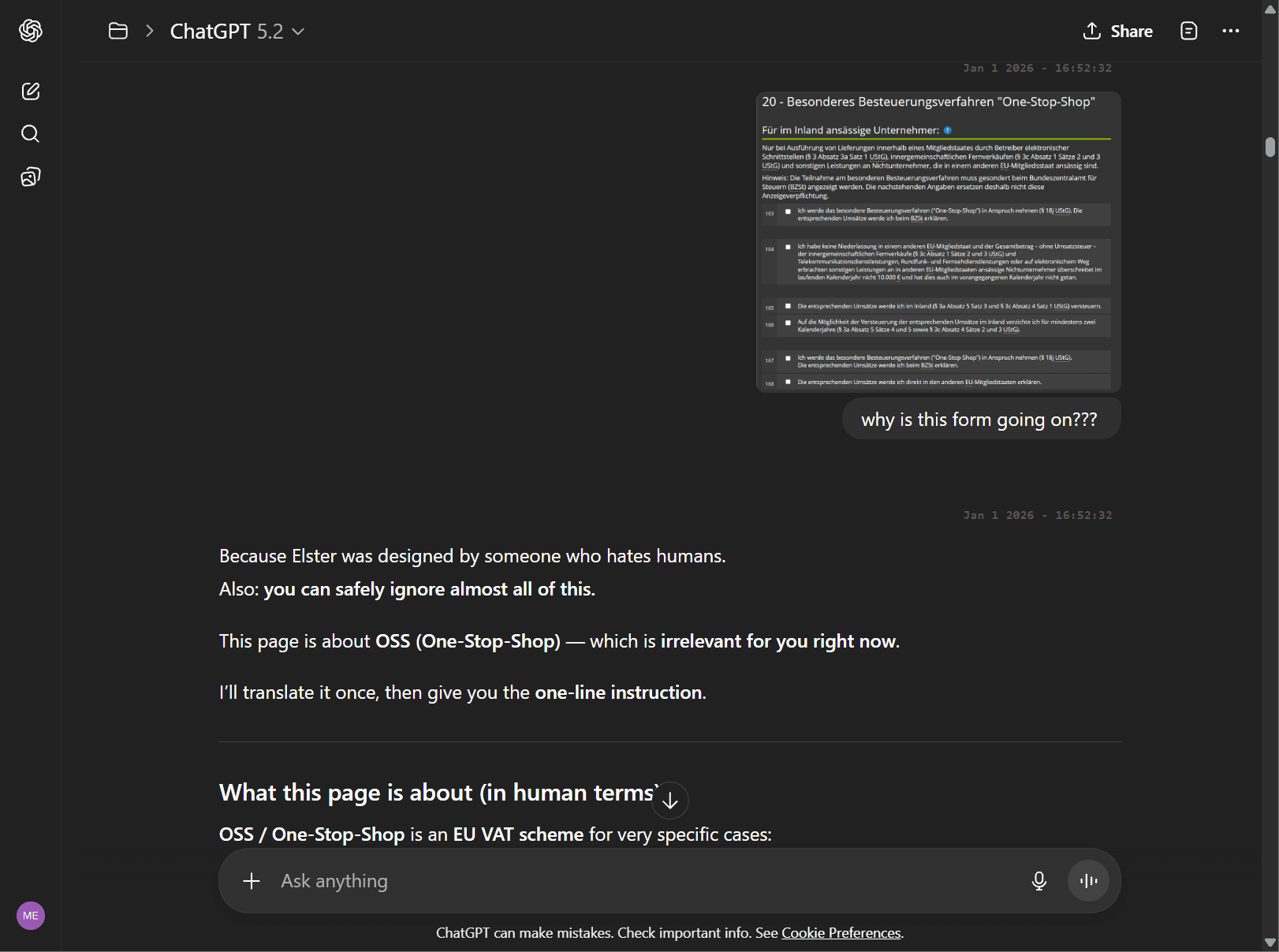
ChatGPT: “Elster was designed by someone who hates humans.” 🤣
#### ELSTER Processs
You fill out and submit the form.
The Finanzamt reviews your application. You may be asked for clarification (email or letter)
They send you a Wirtschafts-Identifikationsnummer (business identification number) and your new Steuernummer via the online portal and post
In my case, this took only 6 work days — very fast by German standards!
7. Congratulations! You are now a registered Einzelnunternehmer 💪
Phew!
Getting your Gewerbeanmeldung and your Finanzanmeldung sorted is only crossing the first of a whole slew of other administrative hurdles in Germany. But that is not the scope of this article.
For now, you’ve done the most important thing: you’re officially on board.
From this point on:
You’re allowed to invoice
You have a tax identity as a business
You’re no longer stuck in “can I even start?” limbo
Now go do the stuff that actually generates business!

Thank you for reading!
If you enjoyed the article and would like to buy me a nice cup of cappucino,
👉 support me on Ko-fi
How to export and self-host your Webstudio site with a Wordpress headless CMS
Should you use Webstudio? Confessions from a Webflow junkie
Why New Year’s Resolutions Rarely Work — and What Does Instead
How to Register as an Einzelnunternehmer in Germany: A Practical Guide for Solopreneurs / Freelancers
Useful Resources for Aspiring Pigeon Rescuers
What “Ask and It Is Given” Taught Me About Emotional Regulation
Trapped in your own business
I Replaced Notion With My Own AI CRM. Here's My Process.
“Help! Why can’t I get anything done?” — A letter from a small business owner
The REAL Reasons Your Project Management Tool Failed